
Talks on Ukraine - This is how Europeans hope to prevent Putin from making fools of them again
At the EU summit in Dublin, European leaders agreed on a negotiating team for talks with Russia. However, it remains to be seen whether these talks will even take place.
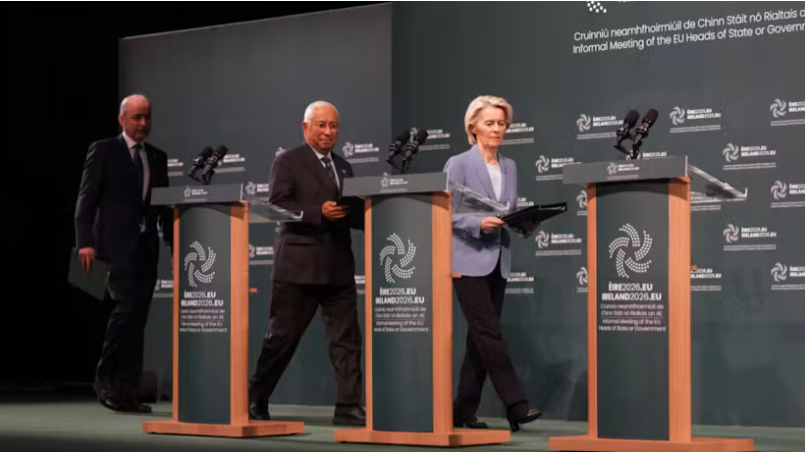
Here's what it's all about
- For a long time now, Europeans have been vying to participate in potential peace talks regarding Ukraine.
- The negotiating team is now ready for potential talks. However, it remains to be seen whether it will actually be called upon.
- Until now, Russia had always refused to let the Europeans have a say.
- Meanwhile, EU Foreign Affairs Commissioner Kaja Kallas is warning Europe against engaging in talks on the European security architecture before a ceasefire is in place.
Europeans have long been working toward securing a seat at the table in talks aimed at ending the war in Ukraine. According to U.S. Special Envoys Jared Kushner and Steve Witkoff, this goal is now within reach. Nevertheless, the participants at the informal EU summit in Dublin had no illusions about Moscow’s intentions—and managed to avoid one of Russia’s “traps.”
This is because Kremlin spokesman Dmitry Peskov held out the prospect of talks only if “the Europeans actually have someone who is at least in some way authorized to negotiate”—thereby alluding to the fact that Europe had not yet been able to agree on a negotiator.
The debate over a negotiating team did indeed accompany Thursday’s European Political Community (EPC) summit as well as Friday’s EU meeting. While smaller member states and the EU institutions themselves backed EU Foreign Affairs Commissioner Kaja Kallas and EU Council President António Costa, other member states favored a less institutional approach.
At the end of the meeting on Friday evening, Costa announced a compromise that had been unanimously agreed upon: The European negotiating team consists of representatives from the so-called E5 countries—Germany, France, the United Kingdom, Italy, and Poland—as well as the European Commission and the Council of the European Union. The decision is not binding, but it puts an end—for now—to a debate that threatened to escalate into a dispute.
Merz: “The Usual Game”
This format corresponds to the group of Europeans who were also present on the sidelines of the talks in Abu Dhabi. Going forward, they are now set to take their place at the negotiating table. According to German Chancellor Friedrich Merz, it is currently “far too early” to consider whether this group will be scaled back at a later date or whether a single lead negotiator might even be appointed. Whether Moscow is actually willing to engage in talks with the “European negotiating team” will become clear in the coming weeks.
This is because Kremlin spokesman Peskov had already cast doubt on Friday on Ukrainian President Volodymyr Zelenskyy’s statement that Europe would “have a voice” at the next meeting. Russia has not yet made a decision on “expanding the format of the talks,” the Kremlin spokesman said. “The usual game,” was how German Chancellor Friedrich Merz characterized Russia’s behavior. “There was a clear message last night. We are in agreement with the Americans,” he emphasized.
"Protect Our Own Interests and Support Ukraine"
Europe has been seeking a seat at the negotiating table for quite some time. Until now, Russia had consistently refused this. After a visit with Kremlin leader Vladimir Putin, U.S. Special Envoys Jared Kushner and Steve Witkoff traveled to Dublin on Thursday to speak with Zelenskyy and several European representatives. Europe will “not be on the sidelines in any way,” Zelenskyy said afterward. Kushner confirmed that an agreement between Ukraine and Russia would not be possible “without Europeans at the table.” Russian President Vladimir Putin is “willing to give it a try.”
EU Commission President Ursula von der Leyen welcomed the news that Europeans will be able to have a direct say in future talks on Ukraine. At the same time, she described this as “self-explanatory.” Europe will “protect its own interests and support Ukraine” in the talks.
Kallas Warns of Putin's Traps
But just how fragile this unity is became clear on Thursday evening in a post by Kushner on X. Expanding the format of the talks would make it possible to “address the broader security arrangements in the European region after the war, along with the territorial issues between Ukraine and Russia,” he wrote there. But it is precisely this shift in focus—from a ceasefire to geopolitical issues—that the Europeans want to prevent. If Europe were to agree to discuss the European security architecture before a ceasefire is in place, “we would indeed be falling into the traps that Russia is setting for us,” warned EU Foreign Affairs Commissioner Kaja Kallas, for example.
Estonian Prime Minister Kristen Michal also warned of a “mental trap.” Putin repeatedly leads Europeans to “talk about our own affairs, but not about the issue that really matters, and that is peace,” he explained.
What's Your Reaction?
 Like
0
 Dislike
0
 Love
0
 Funny
0
 Wow
0
 Sad
0
 Angry
0

Related Posts

-
 Kinguiranke
(103)
-
Nfp
(55)
-
Kankan
(33)
-
Citoyen du monde
(31)
-
Coulibaly Yacouba
(27)



Comments (0)