
France Protests Escalate as Police Crackdowns Fuel Anti-Government Anger
France is facing a wave of anti-government protests following widespread unrest over rising living costs and strained public services. Clashes between demonstrators and police, mass arrests and allegations of excessive force have intensified public anger, raising concerns about the country's political stability ahead of the 2027 presidential election.
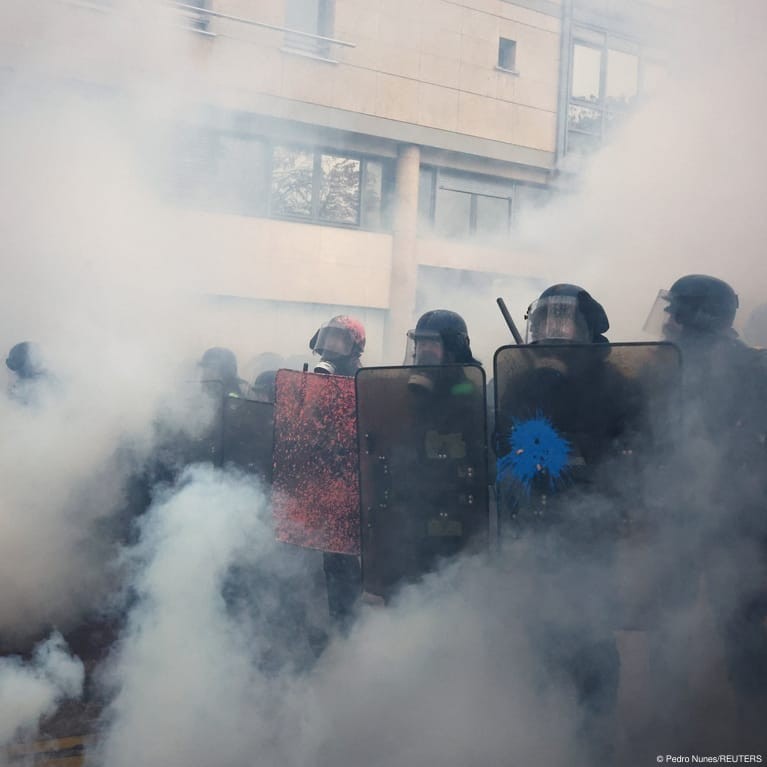
France is facing mounting political and social tensions as nationwide demonstrations over rising living costs, strained public services and education funding have escalated into widespread violence. What began as student-led protests has developed into a broader anti-government movement, with clashes between demonstrators and security forces, mass arrests and growing criticism of police tactics.
The unrest intensified on October 17, when demonstrations across the country turned violent. Shops were looted, vehicles were set on fire and public buildings were attacked in several major cities, including Paris, Marseille and Lyon.
The government's response has added another dimension to the crisis. Thousands of people have been arrested, restrictions have been imposed on demonstrations, and allegations of excessive police force have triggered further criticism from protesters, civil rights organisations and legal professionals.
With the 2027 presidential election approaching, the continuing unrest presents a significant challenge for President Emmanuel Macron's government.
How Student Protests Developed Into Nationwide Unrest
The current wave of demonstrations began in September with relatively small protests over conditions in state schools and concerns about insufficient education funding.
Student groups gradually attracted support from parents, teachers, trade unions and left-wing political figures. Demonstrators increasingly connected their education-related demands with wider frustrations over living costs, rising fuel prices and deteriorating public services.
The October 17 demonstrations marked a major turning point. More than 500,000 people reportedly participated in protests across France, including approximately 110,000 in Paris, according to figures presented by Interior Minister Laurent Nuñez.
Although many participants joined peaceful demonstrations, groups of protesters engaged in confrontations with police. Businesses were vandalised, barricades were erected and fires were reported in several locations.
The scale of the unrest overwhelmed security forces in parts of Paris, Marseille and Lyon. Thousands of businesses were reportedly ransacked during the period surrounding the demonstrations.
The violence also revived memories of the Yellow Vest movement of 2018 and 2019, when protests over fuel prices and economic grievances developed into a major challenge for Macron's government.
Disagreement Over Who Is Responsible for the Violence
French government officials have attributed much of the destruction to far-left activists and individuals they describe as opportunistic looters.
Interior Minister Laurent Nuñez has argued that organised radical groups exploited largely peaceful demonstrations to attack public institutions, businesses and symbols of state authority.
Authorities have also pointed to the use of so-called black bloc tactics, in which demonstrators wear dark clothing and conceal their identities while participating in confrontations and property destruction.
However, the precise role of these groups remains disputed.
Police officers and an intelligence official familiar with the investigations have questioned whether sufficient evidence exists to establish that far-left organisations played the central role described by the government.
Investigators have indicated that further examination is necessary to understand how different groups participated in the violence.
The unrest in Marseille illustrated the seriousness of the situation. Videos showed black-clad demonstrators entering the city hall and damaging public property. Other footage showed groups throwing stones and metal objects at police officers near the Old Port.
In Limoges, a fire engulfed the city's historic town hall, while Lyon's tourism office was also set on fire.
Authorities are investigating suspected involvement in the Limoges incident, including allegations against a 34-year-old carpenter. His lawyers have disputed the accusations and argued that the evidence against their client is insufficient.
Police Crackdowns Add to Public Anger
The government's security response has become one of the most controversial aspects of the demonstrations.
Police have repeatedly used tear gas, batons and crowd-control weapons to disperse protesters. Several young demonstrators have suffered serious injuries, including permanent damage to their hands and eyes.
The treatment of teenagers during school blockades has also attracted criticism. Human rights experts have raised concerns over the detention of nearly 7,000 minors, questioning whether such measures were proportionate.
Footage showing riot police confronting young demonstrators has circulated widely on social media, attracting support for the student movement from people who were not initially involved in the protests.
Parents, teachers, trade union representatives and political activists have subsequently joined demonstrations in several cities.
The French Interior Ministry has confirmed that 161 investigations into allegations of police violence have been opened since September.
Nuñez has acknowledged that some crowd-control operations resulted in serious injuries and expressed regret over the consequences of certain police weapons. However, he has resisted calls to prohibit their use, arguing that security personnel need appropriate means to protect themselves.
The minister has also acknowledged that authorities underestimated the scale of the October 17 demonstrations.
To prevent further violence, the government subsequently deployed additional security personnel, introduced restrictions on public gatherings and prohibited several marches.
Thousands Arrested as Authorities Intensify Legal Action
The French government has adopted a tougher judicial approach towards individuals suspected of participating in the violence.
Justice Minister Gérald Darmanin has called for a firm legal response, including expedited trials and pre-trial detention in relevant cases.
According to figures he presented on November 3, more than 4,900 suspects had been taken into custody since October 17. Approximately 2,290 had been referred for prosecution, while 404 had received prison sentences at that stage.
Most of the suspects were reportedly young men between 18 and 25 years old.
The large number of cases has placed additional pressure on the country's judicial system. The Tribunal de Paris, France's largest courthouse, opened two additional courtrooms to manage expedited proceedings.
However, the speed of some hearings has raised concerns among legal professionals. Some proceedings observed by journalists were postponed because judges had insufficient time to examine case files.
A French judges' and prosecutors' union has also criticised the government's approach, arguing that the justice system risks being used as a political instrument.
Meanwhile, international human rights organisations have raised concerns about proposed legislative measures that could affect the right to peaceful protest.
In November, Human Rights Watch criticised a proposed French bill, warning that provisions targeting protest-related activities could undermine fundamental civil liberties. The organisation called on lawmakers to reject the legislation.
Government Faces Pressure From Protesters and Political Opponents
The unrest comes at a difficult moment for Macron's administration.
France is dealing with strained public finances, while the president's centrist political camp no longer commands a parliamentary majority capable of easily passing major legislation.
The government has attempted to address some of the protesters' demands through proposals aimed at improving education and bringing forward a planned minimum-wage increase.
However, student representatives and major trade unions have argued that these measures are insufficient.
Macron has sought to acknowledge public frustration while maintaining the government's commitment to public order and the authority of state institutions.
The continuing demonstrations indicate that economic concerns, dissatisfaction with public services and disagreements over policing remain unresolved.
The political consequences could become increasingly significant as France approaches its next presidential election. The first round is scheduled for April 18, 2027, followed by a second round on May 2 if required.
Although Macron is constitutionally unable to seek another consecutive term, the political climate surrounding the election is likely to be shaped by the government's handling of the current crisis.
A Cycle of Violence Raises Concerns About France's Future
Researchers specialising in French social movements and policing have warned that aggressive responses to demonstrations can contribute to further escalation.
According to sociologist Fabien Jobard, confrontations between radical protesters and security forces can create a cycle in which violence on one side triggers retaliation from the other.
This dynamic can also influence public perceptions of the demonstrations. Images of police violence may attract additional support for protesters, while attacks on businesses and public buildings strengthen calls for tougher security measures.
For many demonstrators, the protests represent frustration over economic conditions, education and the perceived treatment of young people by authorities.
For the government, however, restoring public order and protecting businesses and public institutions remain major priorities.
The challenge for France will be finding a way to address these competing concerns without allowing further confrontations to deepen the country's divisions.
With demonstrations continuing and political tensions remaining high, the coming months will be important in determining whether dialogue and policy changes can ease the unrest or whether the confrontation between protesters and authorities will continue.
What's Your Reaction?
 Like
0
 Dislike
0
 Love
0
 Funny
0
 Wow
0
 Sad
0
 Angry
0

Related Posts


-
 Kinguiranke
(103)
-
Nfp
(55)
-
Kankan
(33)
-
Citoyen du monde
(31)
-
Coulibaly Yacouba
(27)


Comments (0)